Before You Buy Vanta or Drata: Lighter GRC Options That May Be Enough
5 August 2026 · Humna Ghufran
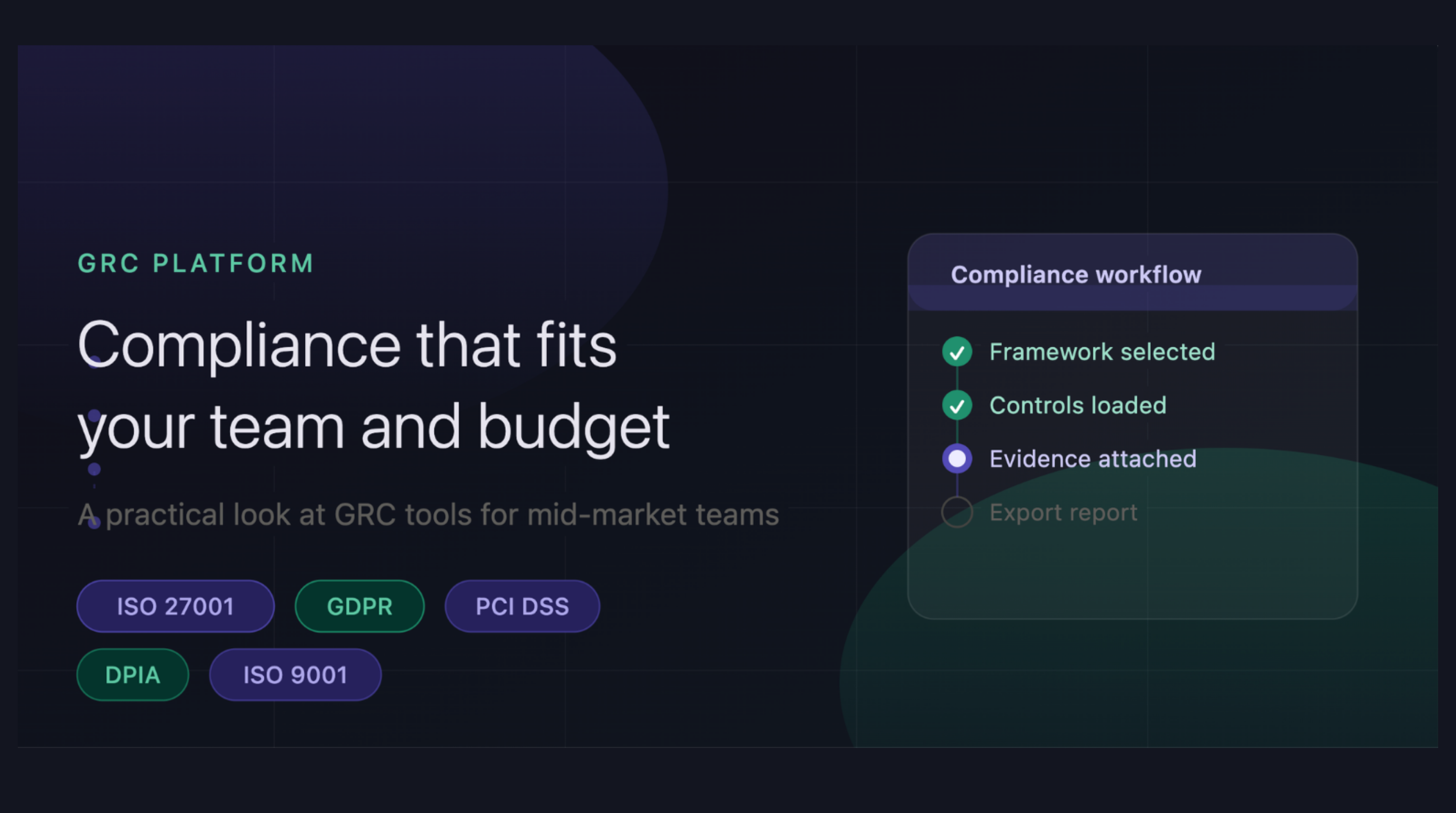
If you have spent any time researching compliance software, you have almost certainly landed on Vanta or Drata. They dominate the search results and both lead G2's Security Compliance category, each rated 4.7 out of 5 across more than a thousand reviews. They are well-funded, well-marketed, and genuinely good products for the companies they were built for.
The problem is that they might not be built for you.
This is not a criticism of either platform. It is just an honest observation about where they sit in the market and why a growing number of companies are looking for something different.
Who Vanta and Drata Are Actually Built For
Vanta and Drata were built around SOC 2 automation for venture-backed SaaS companies — Vanta from 2018, Drata from 2020. The product assumptions baked into both platforms reflect that origin: you have an engineering team that can wire up integrations, a budget that can absorb five-figure annual contracts, and a compliance programme that is primarily about unlocking enterprise sales rather than meeting a regulatory obligation.
That profile fits a specific kind of company. If you are a Series B SaaS business with a sales team closing Fortune 500 deals, the ROI on a Vanta or Drata contract is straightforward. The certification pays for the tool several times over in a single deal.
But that is not the situation most compliance teams are in. Mid-market firms increasingly face enterprise-level compliance demands without enterprise-level resources: fintech companies working toward PCI DSS, professional services firms chasing ISO 27001 for a tender requirement, or SaaS companies that need GDPR documentation in place before they can expand into a new market.
They need the certification. They do not need the enterprise platform that comes with it.
What the Pricing Actually Looks Like
Vanta and Drata are powerful compliance automation platforms, but they can become costly and complex as your compliance program grows. Adding more frameworks, users, or integrations often increases both licensing and implementation effort. Neither vendor publishes list pricing, but procurement data firm Vendr reports that Vanta contracts are structured around framework count, employee count and add-on modules, and that observed Drata contracts run from roughly $10,250 to $42,750 a year (Vendr, 2026). Organizations also typically spend considerable time configuring the platform before they see meaningful value — G2 reviewers note that Vanta's initial setup can be time-consuming, and both vendors run implementation partner programmes for that work.
Take, as an illustration, a 100-person company whose compliance budget is $15,000 for the year. At the low end of Vendr's observed range, spending two thirds of it on tooling before a single control is documented is a difficult argument to make internally. And that assumes the platform actually covers the framework you need.
Both Vanta and Drata have expanded their framework coverage beyond SOC 2 in recent years: Vanta now advertises 35+ frameworks and Drata 30+. In our assessment, though, SOC 2 remains the framework both platforms are best known for and market most heavily, and if you are running ISO 27001, GDPR or PCI DSS programmes you can find yourself working around the edges of a platform that was not designed with those frameworks at its centre.
The Integration Problem
A significant part of what Vanta and Drata sell is automated evidence collection through integrations — Vanta advertises hundreds of them and Drata 170+ native connections. Connect your AWS account, your GitHub, your HR system, and the platform pulls evidence automatically against certain controls.
This is genuinely useful if your control set maps cleanly to what those integrations can capture. For SOC 2 Trust Services Criteria, the overlap is strong. For ISO 27001, which has 93 Annex A controls in its 2022 revision covering everything from physical security to supplier relationships to business continuity, automated integration covers a fraction of what an auditor will actually ask for.
Independent practitioners put the realistically automatable share of an ISO 27001 programme at 20 to 30 per cent; the 70 to 90 per cent figures vendors quote measure something narrower — evidence-collection steps in a cloud-native environment, not the whole programme.
The rest requires manual documentation. Both platforms support it: Drata, for instance, publishes a list of ISO 27001 controls it does not monitor automatically, covering risk assessments, business continuity testing, HR screening, supplier agreements and the Statement of Applicability. That work still has to be done by a person, control by control.
The result is that companies running ISO 27001 or PCI DSS on these platforms can end up maintaining the automated integrations and a separate manual process in parallel — which is exactly the kind of fragmentation they were trying to avoid.
What Most Compliance Teams Actually Need
Strip away the integrations, the dashboards, and the enterprise feature sets, and what an auditor actually wants to see is straightforward: what is in scope, what controls are in place, and where is the evidence. That is the whole job.
Most compliance teams do not need automated evidence collection across hundreds of integrations. They need a structured way to work through their control set, attach the evidence that exists, track what is missing, and produce a report that holds up under scrutiny. They need something that works the same way whether the framework is ISO 27001, PCI DSS, or GDPR, rather than a platform that was optimised for one and adapted for the others.
They also need something they can actually afford to run continuously, not just in the weeks before an audit.
The SMB Compliance Gap
The market Vanta and Drata serve well is real and large. But there is an equally large market of companies that face genuine compliance pressure and cannot justify enterprise tooling to meet it.
A 150-person fintech company working toward ISO 27001 because a banking partner is asking for it. A professional services firm that needs ISO 9001 to qualify for a government tender. A SaaS company expanding into Europe that needs GDPR documentation in place before it can close its next deal.
These are not edge cases. They are a large and fast-growing share of the companies that need compliance support right now: the ISO Survey counted 96,709 valid ISO/IEC 27001 certificates worldwide in 2024, across 179,877 sites.
What they have in common is that the trigger is real and near-term, the budget is constrained, and the team doing the work is in our experience one or two people without a dedicated GRC background. They need tooling that is structured enough to produce something an auditor will accept, and simple enough that a compliance generalist can actually use it without a six-week implementation.
Where RegXperience Fits
RegXperience was built around this gap. One workspace, any framework, built for companies that face real audit pressure without a full GRC team to absorb it.
The way it works is straightforward. Pick a framework and it opens as a guided workflow with the controls or questions already loaded. Work through each control, attach the evidence that backs your answer, and export a structured report when you are done. The same shape applies whether the audit is ISO 27001, a GDPR DPIA, PCI DSS, or a regulation you have uploaded as a PDF.
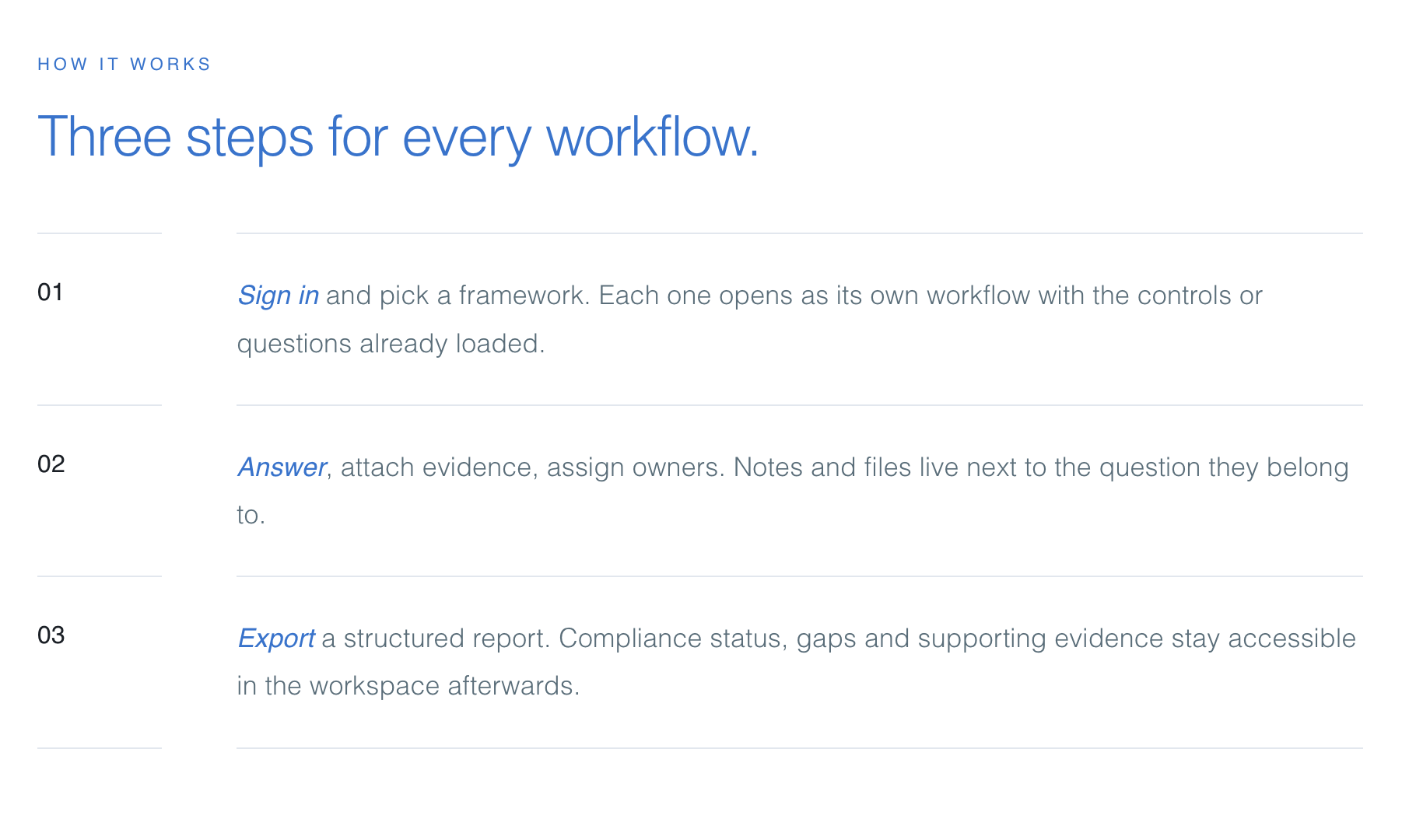 There are no implementation fees and no integration setup. The first workflow is free for a month with no card required, so you can see how a real compliance programme is structured before committing to anything. After that first month, you pay for the workflows you are running.
The pricing is built for the companies we serve. You pay for what you are running, only for as long as you need it. A company working toward a single ISO 27001 certification is not paying for a platform built around hundreds of integrations it will never use.
RegXperience: One Workspace for Every Framework You Need
If you are a venture-backed SaaS company closing enterprise deals and SOC 2 is the primary certification you need, Vanta and Drata are worth evaluating seriously. They are mature products with strong integration ecosystems and the market position to back them up.
If you are a mid-market company facing a real compliance trigger, working toward ISO 27001, PCI DSS, or GDPR, and operating without a dedicated GRC team or an enterprise tooling budget, you are paying for a platform that was not designed with your situation in mind.
The compliance work is the same. The tooling does not have to cost the same.
If that is where you are, take a look at what we are building at regxperience.tech. The first workflow is free and there is no sales call required to see how it works.